
THE
NATIONAL NURSERY BOOK
PREFACE.
The Publishers offer in this little volume well known and long loved stories to their young readers. The tales which have delighted the children of many generations will, they feel assured, be equally welcome in the nurseries of the present day, which, with the popularity and antiquity of the contents of the volume, justify them in styling it The National Nursery Book.

OLD MOTHER HUBBARD.
Old Mother Hubbard
Went to the cupboard
To get her poor Dog a bone;
But when she came there
The cupboard was bare,
And so the poor Dog had none.
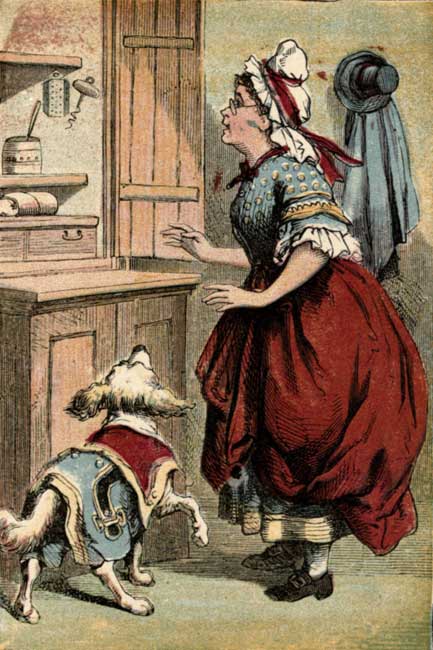 OLD MOTHER HUBBARD AND HER DOG.
She went to the baker’s
To buy him some bread,
But when she came back
The poor Dog looked dead.
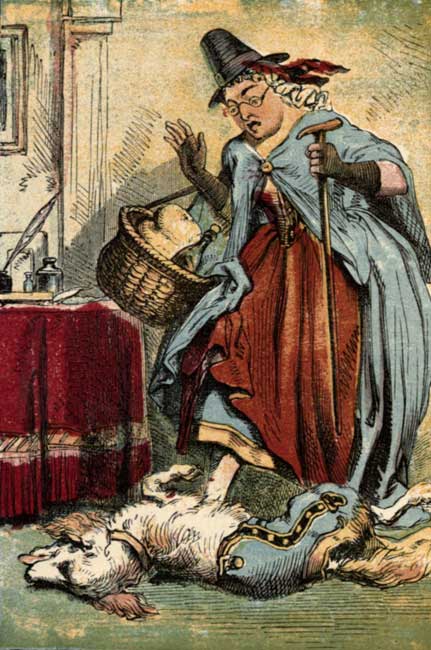 THE DOG LOOKING DEAD.
She went to the hatter’s
To buy him a hat,
But when she came back
He was feeding the cat.
She went to the barber’s
To buy him a wig,
But when she came back
He was dancing a jig.
She went to the joiner’s
To buy him a coffin,
But when she came back
The poor Dog was laughing.
She took a clean dish
To get him some tripe,
But when she came back
He was smoking a pipe.
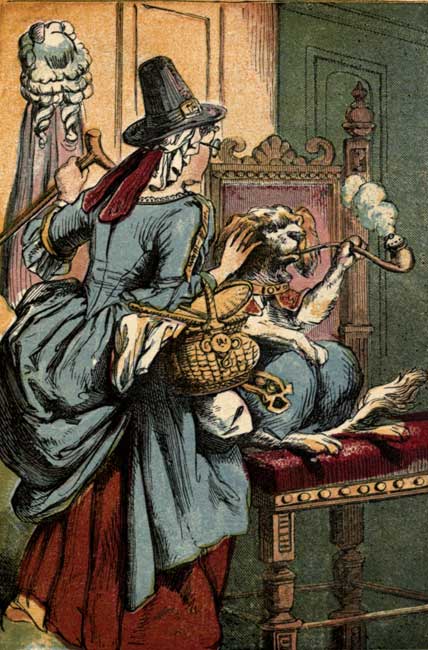 THE DOG SMOKING A PIPE.
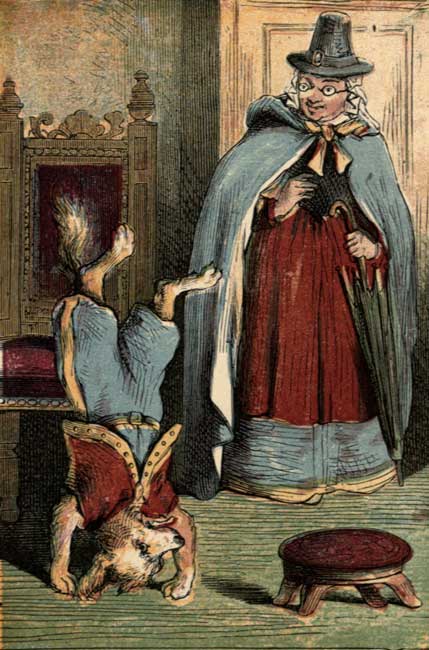 THE DOG STANDING ON HIS HEAD.
She went to the ale-house
To get him some beer,
But when she came back
The Dog sat in a chair.
She went to the tavern
For white wine and red,
But when she came back
The Dog stood on his head.
She went to the fruiterer’s
To buy him some fruit,
But when she came back
He was playing the flute.
She went to the tailor’s,
To buy him a coat,
But when she came back
He was riding a goat.
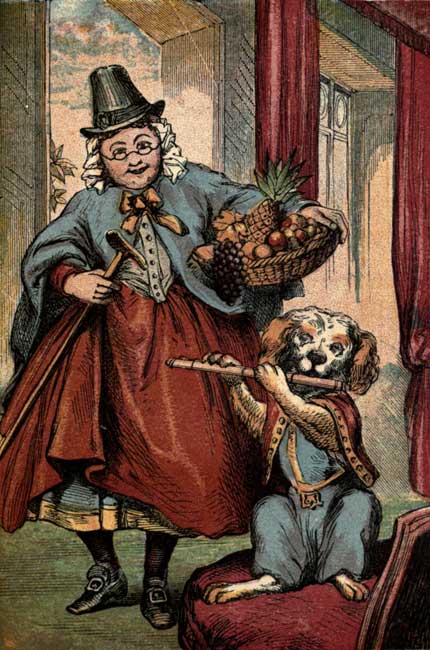 THE DOG PLAYING THE FLUTE.
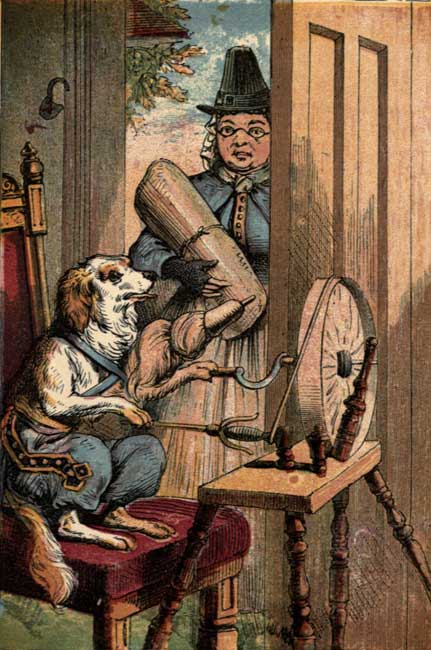 THE DOG SPINNING.
She went to the sempstress
To buy him some linen,
But when she came back
The Dog was a-spinning.
She went to the hosier’s
To buy him some hose,
But when she came back
He was dressed in his clothes.
She went to the cobbler’s
To buy him some shoes,
But when she came back
He was reading the news.
The Dame made a curtsey,
The Dog made a bow;
The Dame said, “Your servant;”
The Dog said, “Bow-wow!”
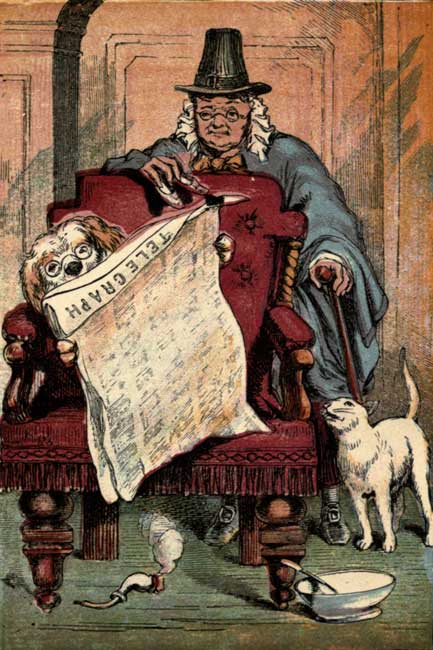 THE DOG READING THE NEWS.
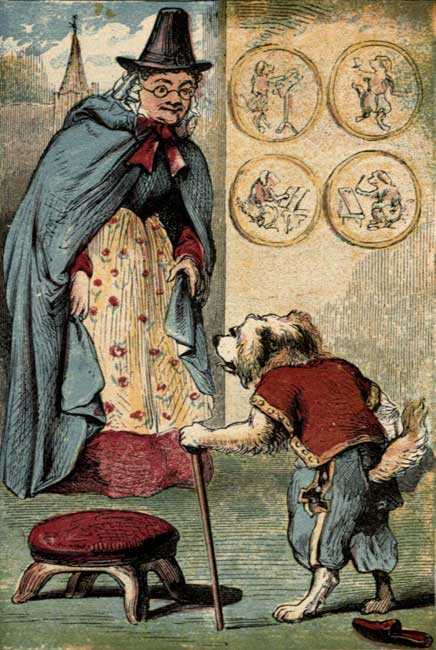 THE DOG MADE A BOW.
This wonderful Dog
Was Dame Hubbard’s delight;
He could sing, he could dance,
He could read, he could write.
So she gave him rich dainties
Whenever he fed,
And erected a monument
When he was dead.
COCK ROBIN.
Who killed Cock Robin?
I, said the Sparrow,
With my bow and arrow.
I killed Cock Robin.
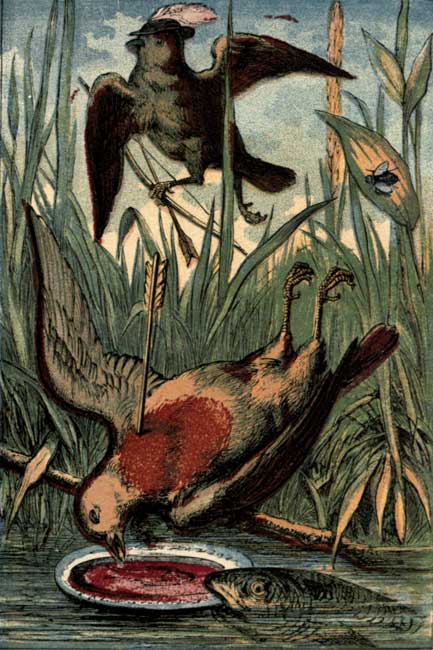 THE SPARROW, COCK ROBIN, AND THE FISH.
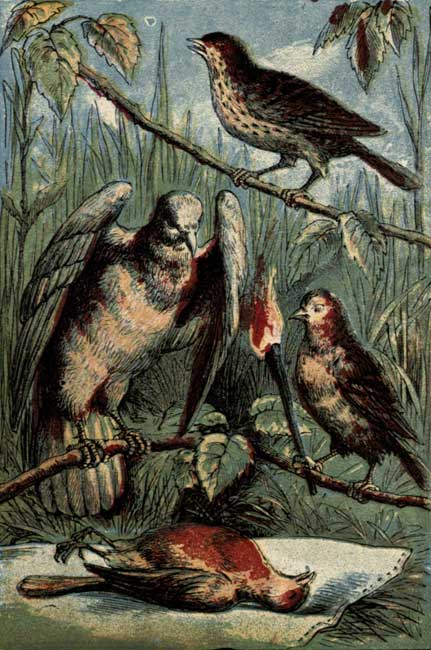 THE LINNET, THE DOVE, AND COCK ROBIN.
Who saw him die?
I, said the Fly,
With my little eye.
I saw him die.
Who caught his blood?
I, said the Fish,
With my little dish.
I caught his blood.
Who’ll carry him to the grave?
I, said the Kite,
If it’s not in the night.
I’ll carry him to the grave.
Who’ll carry the link?
I, said the Linnet,
I’ll fetch it in a minute.
I’ll carry the link.
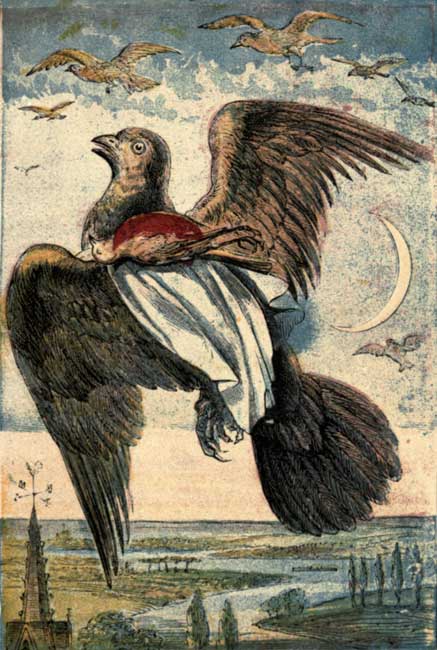 THE KITE AND COCK ROBIN.
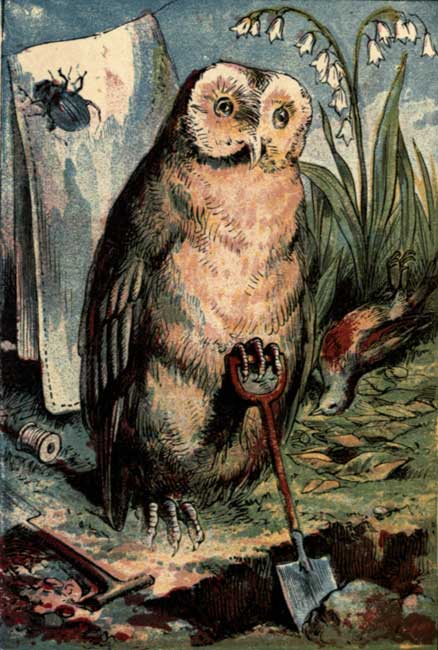 THE OWL, THE BEETLE, AND COCK ROBIN.
Who’ll make his shroud?
I, said the Beetle,
With my thread and needle.
I’ll make his shroud.
Who’ll dig his grave?
I, said the Owl,
With my spade and shovel.
I’ll dig his grave.
Who’ll toll the bell?
I, said the Bull,
Because I can pull.
I’ll pull the bell.
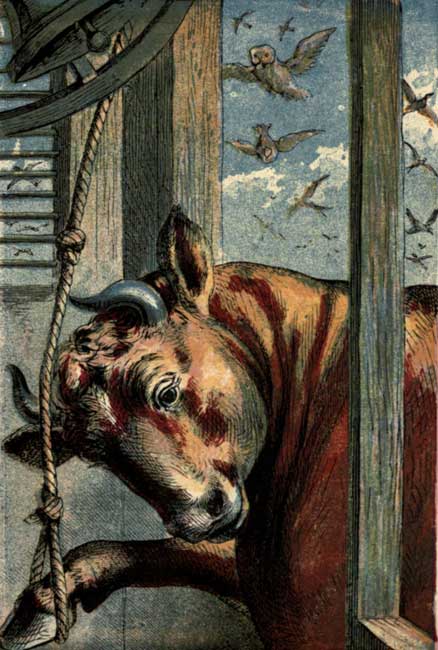 THE BULL TOLLING THE BELL
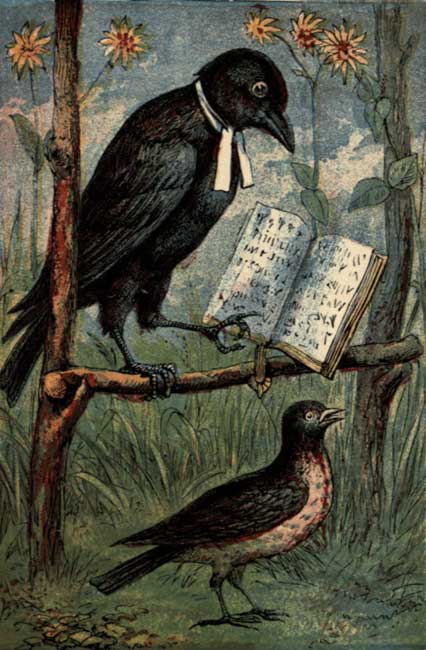 THE ROOK AND THE LARK
Who’ll be the Parson?
I, said the Rook,
With my little book.
I’ll be the Parson.
Who’ll be the Clerk?
I, said the Lark,
If it’s not in the dark.
I’ll be the Clerk.
Who’ll be chief mourner?
I, said the Dove,
For I mourn for my love.
I’ll be chief mourner.
Who’ll sing a psalm?
I, said the Thrush,
As she sat in a bush.
I’ll sing a psalm.
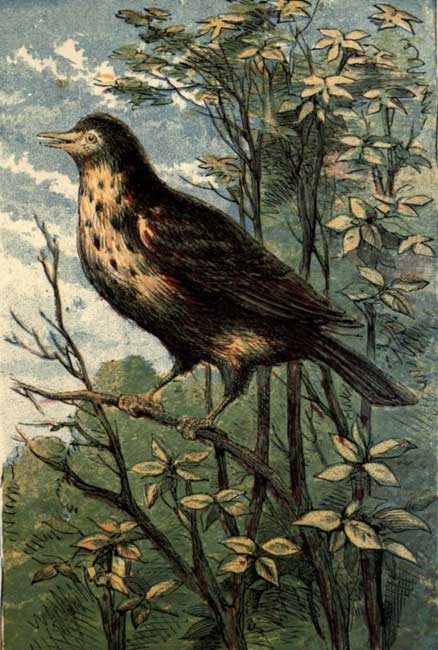 THE THRUSH.
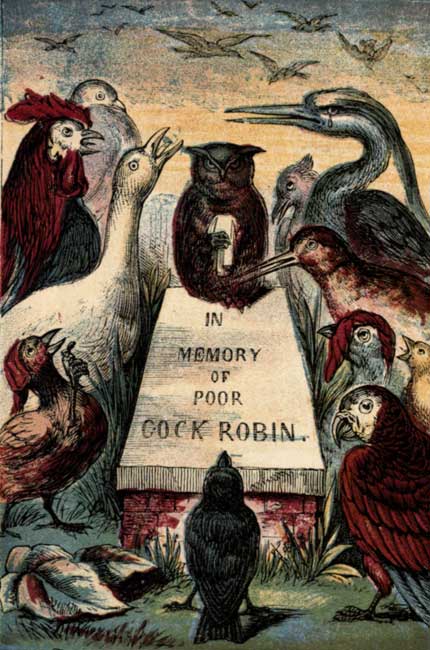 SIGHING AND SOBBING FOR POOR COCK ROBIN.
All the birds of the air
Fell a-sighing and sobbing
When they heard the bell toll
For poor Cock Robin.


TOM THUMB.
In the days of good king Arthur there lived a countryman and his wife who, though they had plenty to eat and to drink, and a very comfortable cottage to live in, were not at all happy.
They had no children, and they both wished very much for a baby. The wife was often in tears when her husband was out at work and she was all alone, because she had not an infant to take care of and nurse. One day, as she sat weeping by herself, more than usually sad, she said aloud, “If I only had a dear little baby, I should not care what it was like. I should be thankful for one if it were no bigger than my husband’s thumb.”
Now it happened that the Queen of the Fairies was passing by, though the poor woman could not see her, and as she knew the farmer’s wife was kind to the poor and likely to be a good mother, she thought she would grant her wish.
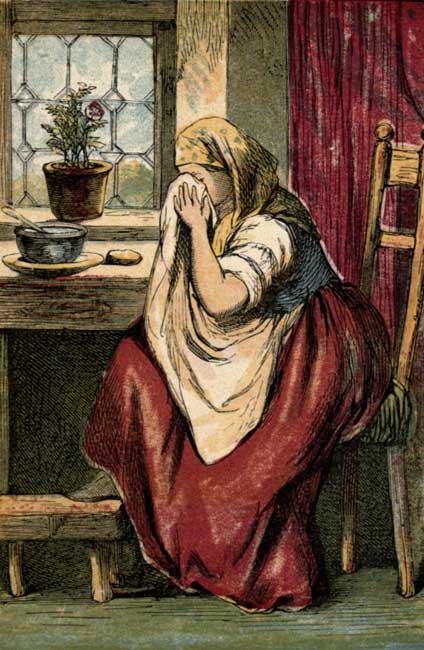 THE FARMER’S WIFE CRYING BECAUSE SHE HAS NO BABY.
So about an hour or two afterwards the woman was much surprised to see standing by the table a very beautiful lady, dressed splendidly, with a glittering star on her forehead and a wand in her right hand, with a gem of great brilliancy at the top of it. But what delighted the woman most of all was a tiny cradle, made of a walnut shell, lined with velvet, in which lay the prettiest baby ever seen, but it was only just as large as a man’s thumb. “See,” said the fairy, “your wish is granted. Here is a baby for you. Take care of it; it is your own.” The woman did not know how to thank the fairy enough; she was so delighted, and the queen went away quite pleased at having given so much happiness.
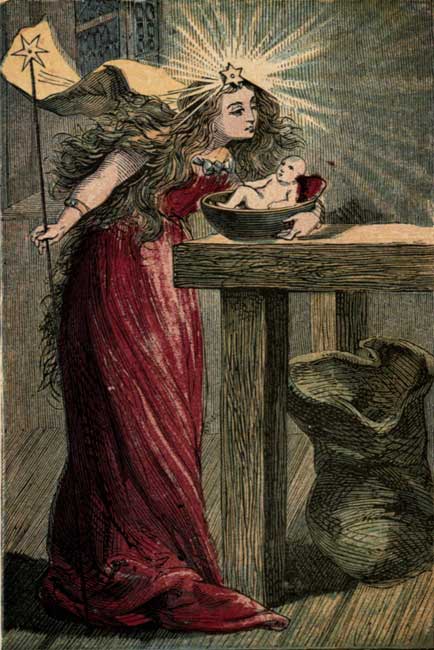 THE FAIRY QUEEN BRINGING TOM THUMB TO HIS MOTHER.
Before the fairy went away, however, she gave the woman a little shirt of spider’s web and a doublet of thistle-down for the baby.
When the farmer came home he was very much pleased. He invited all his friends to the christening, and the child was named “Tom,” after him, and “Thumb,” because he was no bigger than one.
The baby was very well, and merry, and grew, of course; but still it was very small.
However, at last Tom thought himself quite a great boy, and begged his mother to make him a little suit of clothes, and she made him one; but with a great deal of trouble, they were so small.
Tom was very often in mischief. He was so small that his mother used to put him on the table to play; and once she found him in the salt-box.
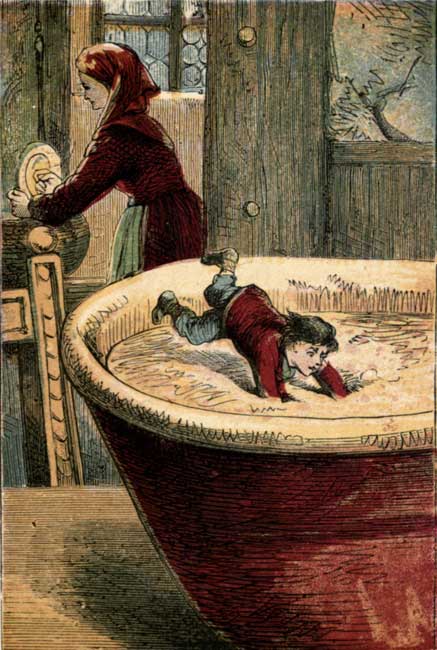 TOM FALLS INTO THE PUDDING.
One day she was making a plum-pudding, and Tom stood by the side of the basin, and peeped over the edge; but he could not see into it very well, and while his mother was gone for some more flour, he drew himself up on the edge of the basin. Alas! he fell in and disappeared in the wet pudding, which for poor Tom was a huge morass.
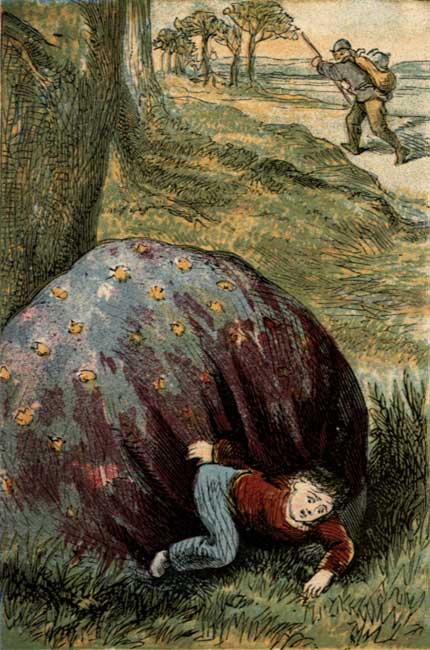 THE FALL OF THE PUDDING.
Tom would have cried out, but the pudding stuck his lips together, and his mother not missing him, stirred him up in the mixture, and put it and him into the pot. Tom no sooner felt the hot water than he danced about like mad; the woman was nearly frightened out of her wits to see the pudding come out of the pot and jump about, and she was glad to give it to a tinker who was passing that way. The tinker took the pudding and put it into a cloth, to carry it home to his family, who seldom tasted such a good dish.
But by-and-by, as he was climbing over a stile, he happened to squeeze it, and Tom, who had made quite an arch over his own head in the dry pudding by this time, cried out from the middle of it, “Hallo, Pickens!” which so terrified the tinker that he let the pudding drop in the field and scampered off as fast as he could. The pudding fell to pieces in the fall, and Tom, creeping out, went home to his mother, whom he found in great trouble, because she could not find him.
After this accident, Tom’s mother never let him stay near her while she was cooking, but she was obliged to take him with her when she went out milking, for she dared not trust the little man in the house alone.
A few days after his escape from the pudding, Tom went, with his mother, into the fields to milk the cows, and for fear he should be blown away by the wind, she tied him to a thistle with a small piece of thread.
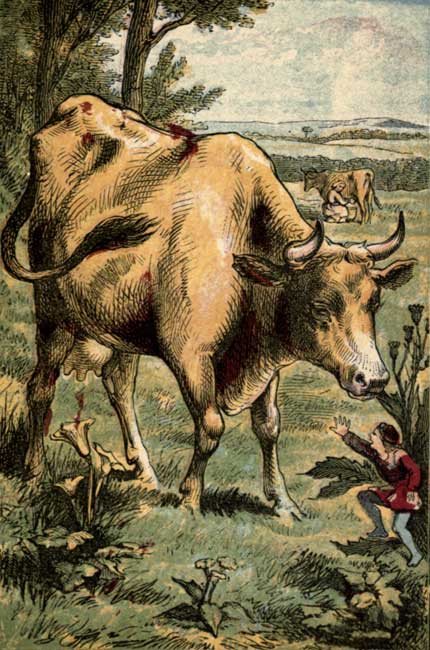 THE COW EATS TOM.
Very soon after, a cow eat up the thistle and swallowed Tom Thumb. His mother was in sad grief again; but Tom scratched and kicked in the cow’s throat till she was glad to throw him out of her mouth again, and he was not at all hurt; but his mother became very anxious about her small son, who now gave her a great deal of trouble. Sometimes he fell into the milk-pail and was nearly drowned in the milk; once he was nearly killed by an angry chicken, and another time had a narrow escape from a cat.
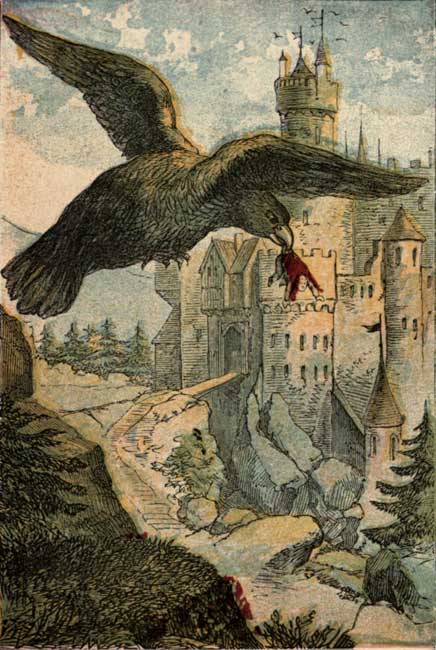 THE EAGLE FLIES AWAY WITH TOM.
One day Tom went ploughing with his father, who gave him a whip made of a barley straw, to drive the oxen with; but an eagle, flying by, caught him up in his beak, and carried him to the top of a great giant’s castle, and dropped him on the leads. The giant was walking on the battlements and thought at first that it was a foreign bird which lay at his feet, but soon seeing that it was a small man, he picked Tom up with his finger and thumb, and put the poor little creature into his great mouth, but the fairy dwarf scratched the roof of the giant’s mouth, and bit his great tongue, and held on by his teeth till the ogre, in a passion, took him out again and threw him over into the sea, which ran beneath the castle walls. Here a very large fish swallowed him up directly.
Tom did not at all like swimming about in the fish, but by-and-by he felt it drawn upwards, and guessed at once that it was caught. And so it was; and being a very large fish, the fisherman thought it would make a good present for his beloved King Arthur. So he took it to the palace and begged the king to accept it.
King Arthur was pleased with the poor man’s affection, and ordered the fish to be carried to the kitchen and cooked for his own dinner. The fisherman took it to the cook, who admired it very much, but said it was very heavy. Then he laid it on a table and began to cut it open. You may imagine how he jumped with fear and wonder when Tom Thumb slipped out of the fish!
The cook’s cries brought the other servants, and soon everybody near ran to behold this wonder—the tiny man who came out of the fish.
Tom begged for some water to wash himself, and when he was clean, the courtiers thought him so pretty and such a marvel that they ran to tell the king about him.
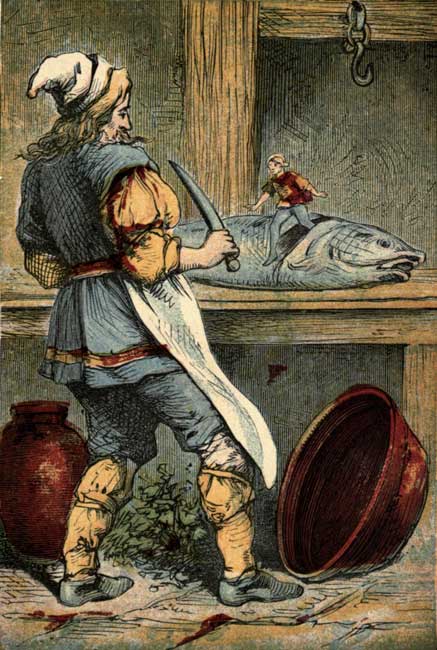 TOM COMES OUT OF THE FISH.
Arthur was very much surprised; but he desired them to send the little man up after dinner to see him, and the Court tailor made haste at once to get ready a Court suit for Tom, which did not take him long to make; there were so few stitches in it!
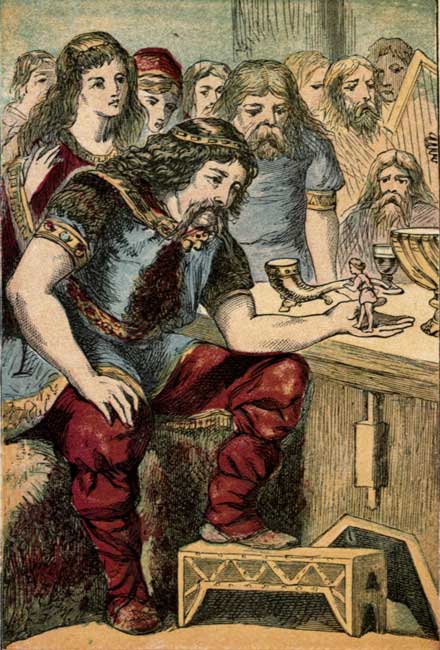 KING ARTHUR RECEIVING TOM THUMB.
As soon as the king’s great punch-bowl was set on the royal table, Tom Thumb was carried to see the monarch, who was delighted with the little man. Tom walked on the King’s hand, and danced on the Queen’s. He became a great favourite with Arthur, who made him a knight. Such is the wonderful history of Tom Thumb, who did much good when he grew older, and thus proved that however small people are, they may be of use in the world. He was good and kind to his parents, and to everybody; and the old ballad says,—
“Such were his deeds and noble acts
In Arthur’s court there shone,
As like in all the world beside
Was hardly seen or known.”
PUNCH AND JUDY.
Mr. Punch and his wife
Led a terrible life,
Very much like a dog and a cat;
Till, one summer morn
A baby was born,
A darling all dimples and fat.
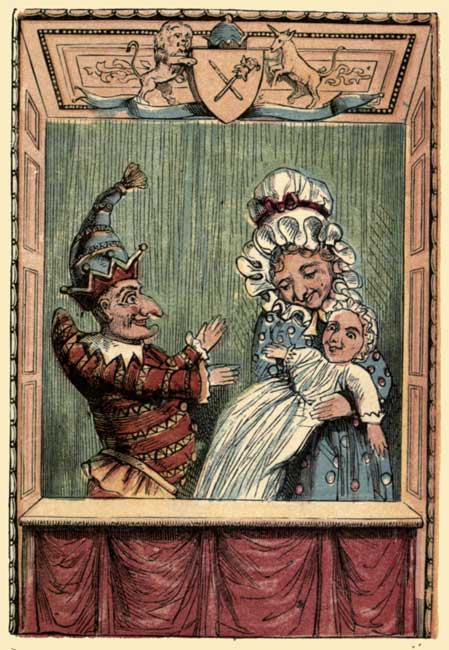 PUNCH, JUDY, AND THE BABY.
Mrs. Judy was proud,
And the nurses allowed
That they never had seen such a child;
And the proud mother thought
When her baby she brought
To her husband, “It must make him mild.”
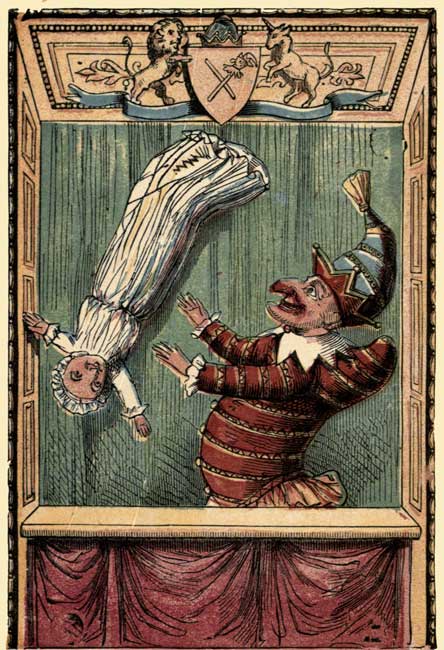 PUNCH AND THE BABY.
Mr. Punch was quite pleased;
The poor baby he seized,
And danced up and down in great joy.
“Oh, my Judy,” he cried,
“With a father’s just pride,
I look on our beautiful boy.”
But the baby soon cried;
Punch’s temper was tried,
And in a great passion he flew;
He shook the poor child,
And, with rage growing wild,
The babe o’er the balcony threw.
Judy, greatly displeased,
A thick stick at once seized,
And began her stern husband to beat;
“O you monster,” she cried,
As her weapon she plied,
“You deserve the same ending to meet.”
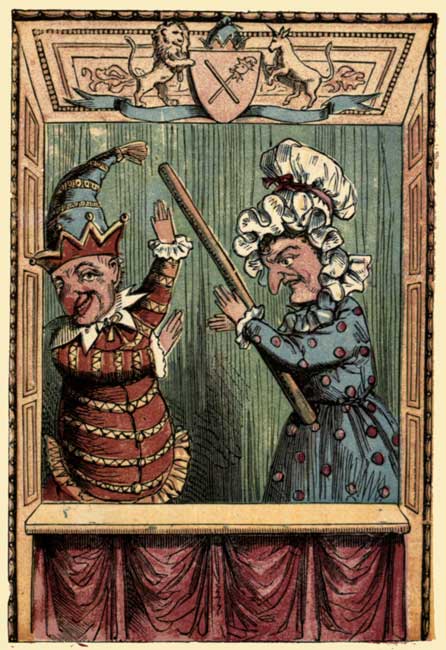 PUNCH AND JUDY.
On his arms and his head
Her blows fell like lead;
She wonder’d such treatment he stood!
Beating and battering,
She made such a clattering,
It sounded like chopping up wood.
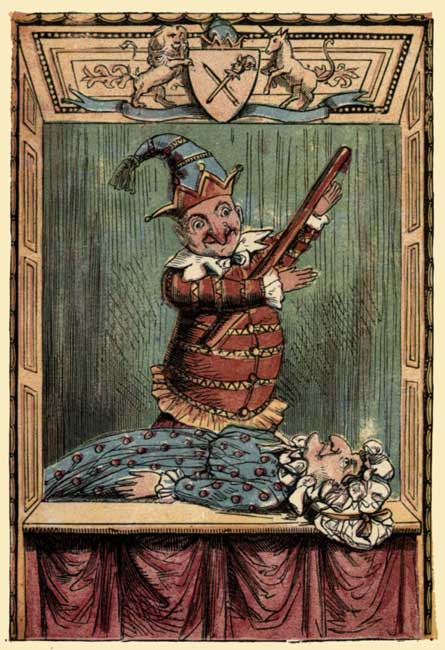 PUNCH KILLS JUDY.
Of his beating quite tired,
Punch’s patience expired;
He snatched the stick out of her hands,
And gave Judy a blow
Which, alas, laid her low,
And above her a conqueror stands.
Then he danced and he sang,
And such nonsense began,
That we laughed, though we couldn’t tell why;
For in such a sad case
It were much more our place
For Judy’s misfortunes to cry.
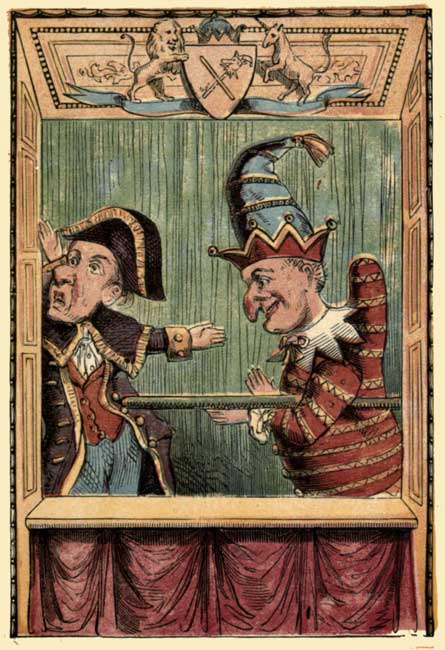 PUNCH AND THE CONSTABLE.
But the constable see!—
“Are you come here for me?”
Cries Punch, as he dances about.
“Yes, yes; come to jail,
‘Tis a terrible tale,”
Said the constable, “you must come out,
“And be tried for your life,
For thus killing your wife;
In prison, meantime, you’ll abide.”
“Oh no, I won’t go,”
Cried Punch, and a blow
He gave the poor man in his side.
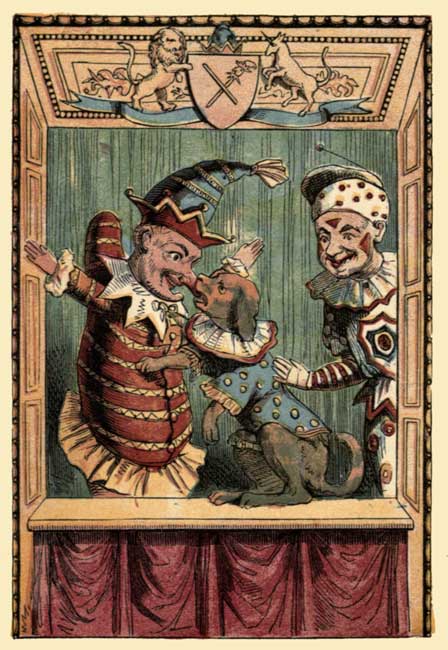 PUNCH, TOBY, AND THE CLOWN.
Now Punch had a pet
Whom we must not forget,
A dog known as Toby by name;
A clown from a show
One day came to know
If Punch would not sell him the same.
But Punch would not part
From his dog, for his heart
(Though a wooden one) to him was true.
He cried, “Give me a kiss,
Dear Toby, I wis
I never will sever from you.”
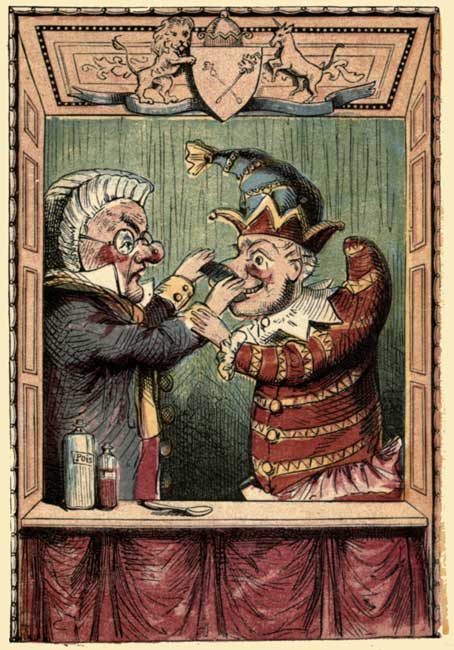 PUNCH AND THE DOCTOR.
But Jack Ketch comes at last;
Punch’s frolics are past,
There is no one his cause to befriend;
His nonsense and fun
Are all, alas, done;
He has come to a very bad end!
If he were not of wood
It would not be good
To laugh at the harm he has done;
But ’twas only pretence,
And there was not much sense
In his crimes, or his grief, or his fun.
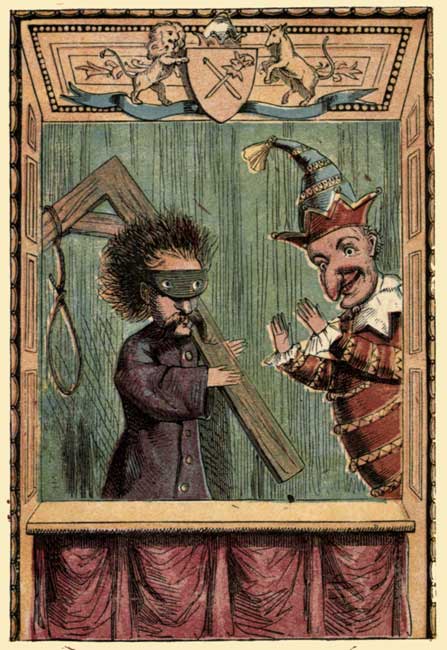 PUNCH AND JACK KETCH.
For a great many years,
Punch’s laughter and tears,
Have amused both the child and the man;
So I think at the last,
For the sake of the past
We will keep him as long as we can.
THE PETS.
THE SHEEP.
The sheep is a very useful animal. Its wool, sheared off, makes us cloth and flannel, and all kinds of woollen goods; and its flesh, called mutton, is a chief part of our food. When sheep are little they are called lambs, and are very playful, pretty creatures.
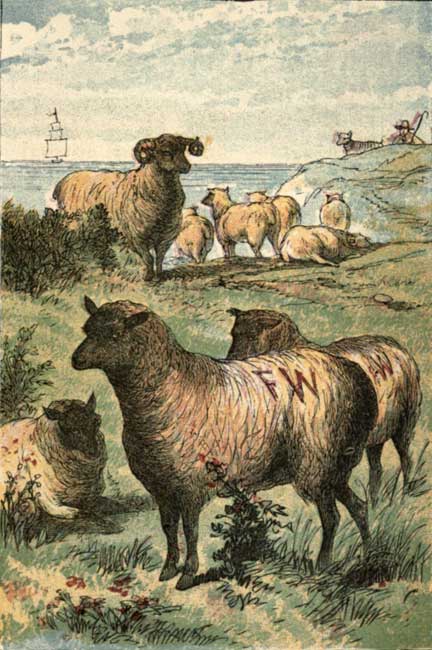 SHEEP.
Sheep soon learn to know the voice of their shepherd, and will follow it. In Eastern countries the shepherd walks before his flock, and they are led by his voice. There are dogs called sheep-dogs, which take care of the flocks, and protect the sheep, and keep them together. In some countries these dogs have often to fight with wolves, which attack the sheep and carry them off whenever they can; but the dogs are quite able to keep the wolf away when they are trained to do so.
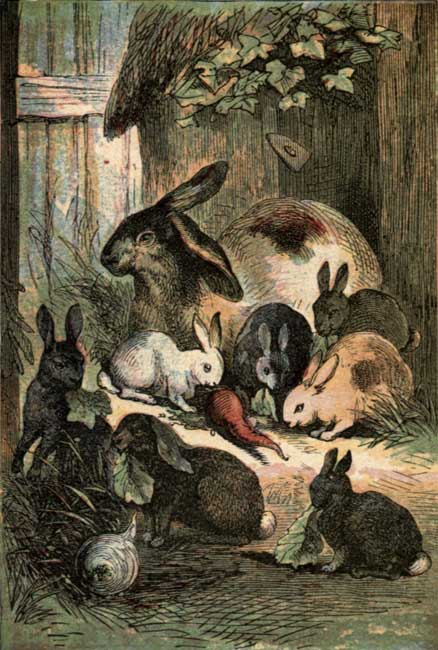 RABBITS.
On the Scottish hills the sheep-dog is often obliged to seek his charge in the snow-drifts, and to help get out a poor sheep or lamb which has got buried in it. Sheep love green meadows and pure water. You remember, I dare say, the beautiful Psalm, “The Lord is my shepherd, therefore I shall lack nothing.”
RABBITS.
Are the favourite pets of boys. They are merry little creatures, and it is an amusing sight to watch them running over the green turf about their warren, when they are free. They have many enemies, however, such as dogs, foxes, and weasels. But, in spite of their enemies, rabbits live a merry life together.
There are a great many different kinds of tame rabbits; some are white, with pink eyes and long ears. Rabbits have many young ones. One pair will have fifty-six little rabbits in a year. So it is lucky many other creatures feed on them. If they were left to increase, they would soon eat up every stalk of corn and all the green herbs.
The native country of the rabbit is Spain. In the Orkney Islands, where there are great numbers of rabbits, the wild ones are of a grey colour, and in winter time almost white.
The fur of the rabbit is much used for making hats. They are good for food also.
THE COW.
Is a very valuable animal; indeed I do not know what we should do without her. She gives us milk and butter, cheese and cream; her skin is of great use, and her flesh is often eaten as beef. Cows grow fond of those who are kind to them.
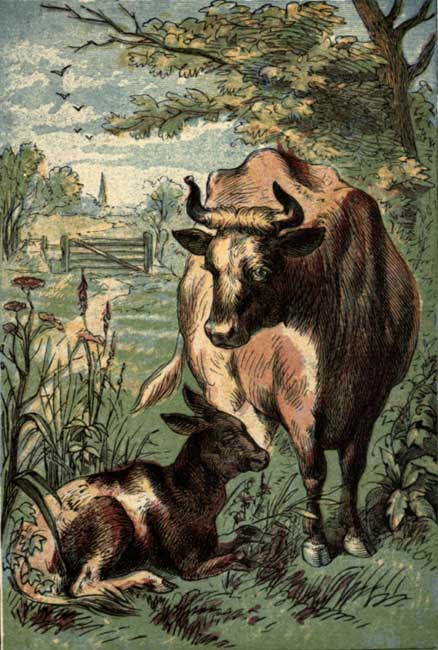 COW AND CALF.
There are a great many different kinds of cows; some red, some black, some brindled, white or spotted. Herefordshire cows have white faces. The ancient Britons had great numbers of fine cows; and wild cattle were common in our country seven hundred years ago. In the neighbourhood of London, in Henry II.’s reign, there was a large forest which contained a great many wild bulls and cows.
 THE DONKEY.
The cow is a good mother, very fond of her calf. The bull is a very bold, fierce animal. It has a great dislike to the colour red, and will run after and if it can toss any one wearing it. In Spain they have a cruel sport, called bull fights, between these brave animals and men on horseback.
The flesh of the cow and ox is called beef; that of the calf is veal.
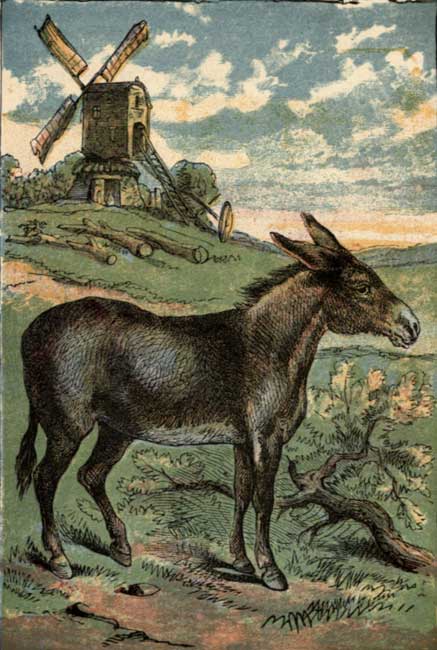
THE DONKEY.
This patient and useful animal is supposed to have come at first from the East, where it still continues to be of a greater size and of a much better appearance. They were as valuable there in former ages as horses; great men and judges rode on asses. The ass is very fond of its foal, and can be attached to its master if kindly treated. Its milk is thought very good for consumptive people. It is very sure-footed, and strong, and able to carry heavy burdens.
The Donkey is a very useful animal to the poor. It can do a great deal of work on very coarse and cheap food. Thistles make a dainty dinner for the ass. It is patient and gentle, but occasionally very obstinate; a fault chiefly produced in the poor beast by ill-usuage.
Children should never be cruel to this poor animal, but treat it kindly, and it will not then be stubborn and slow, but will do its best to carry them.
THE COCK, THE HEN, AND THE CHICKENS.
Here is a fine farm-yard family! very useful friends of ours. The cock, who is a brave, spirited bird, wakes us up in the morning by crowing; the hen lays us eggs for breakfast, and when the wee chicks are big enough, they are very good food, as roast chicken. The cock teaches us watchfulness; the hen, motherly love.
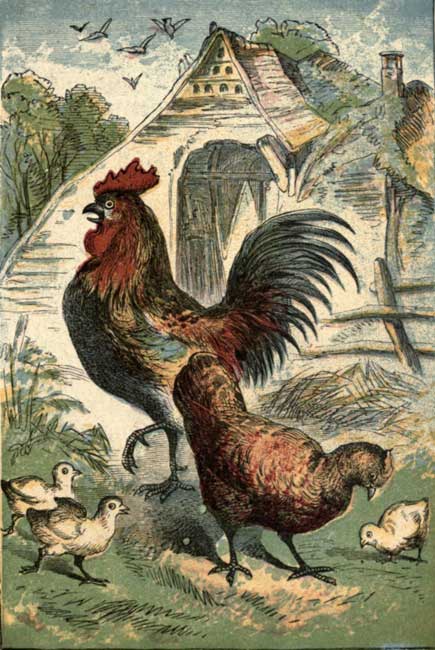 THE COCK, THE HEN, AND THE CHICKENS.
There are many different kinds of fowls. The largest are the tall Cochin Chinas; the smallest the pert little Bantams. It is a great amusement for children to have a few fowls to feed, and take care of. Feeding them and finding their eggs is one of the country child’s pleasures.
The hen sits on her eggs for three weeks; and when the chicks are hatched, she takes the greatest care of them, gathering them under her wings when danger is near or the weather is at all cold; and she is ready to fight a hawk or even a dog in defence of her little ones.
Fowls feed on barley or any kind of grain, and pick up worms, &c., in their run. Stinging-nettles are very good food for chickens.
THE HORSE.
This noblest of animals is believed to be a native of Arabia; but was in our islands before the Romans came here. The first money coined in Britain was stamped with the figure of a horse.
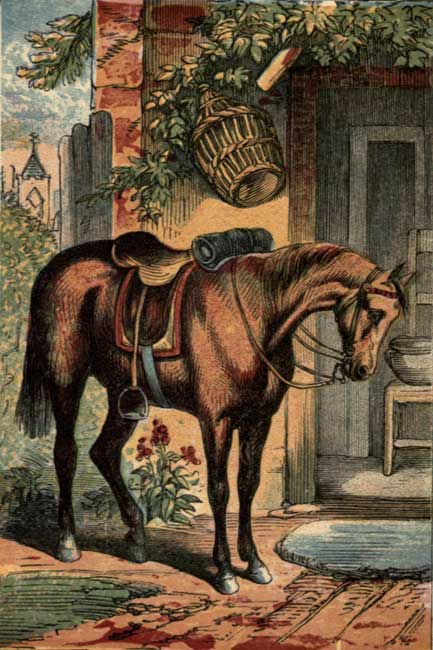 THE HORSE.
The horse has a wonderful memory. He never forgets a place to which he has once been taken. He loves his master if well treated; and in battles he displays the greatest courage and joy. He also understands sounds, and loves music. Indeed, the horse may be called the friend of man, and deserves all the kindness we can show him.
The Arabs bring up their horses with their children in their own tents; and the steed thus reared is very sensible and gentle. An Arab will not sell his favourite horse for any sum, however large: it is as dear to him as his children.
THE GOAT.
The goat is a very useful animal. Its flesh is very good, though English people seldom eat it. Its milk is very good also, and of use to people in consumption. The most beautiful gloves are made from its skin.
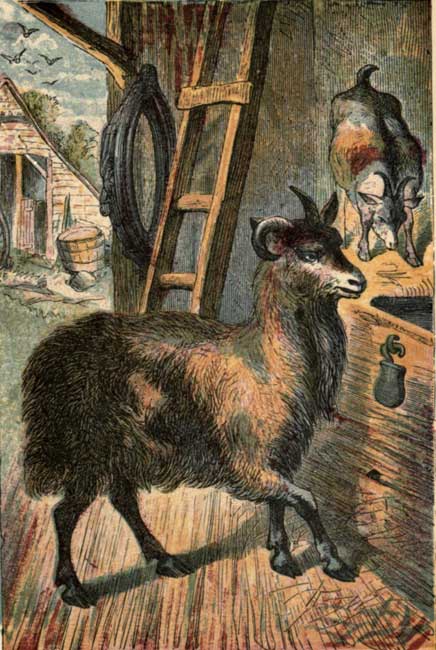 GOATS.
Goats abound on the Welsh mountains; it is, indeed, an animal that loves the great hills. The Welsh goats are white; they are very active, and walk on the brink of precipices, and take the most wonderful leaps. The scent of a goat is unpleasant, but it is thought to prevent infection amongst cattle.
Horses are very fond of goats. They are more common in France than with us. In that country one sees a goat with nearly every flock of sheep.
Goats’ flesh is called “kid.” Do you remember how Jacob deceived his father with the skin and meat of a kid of the goats?
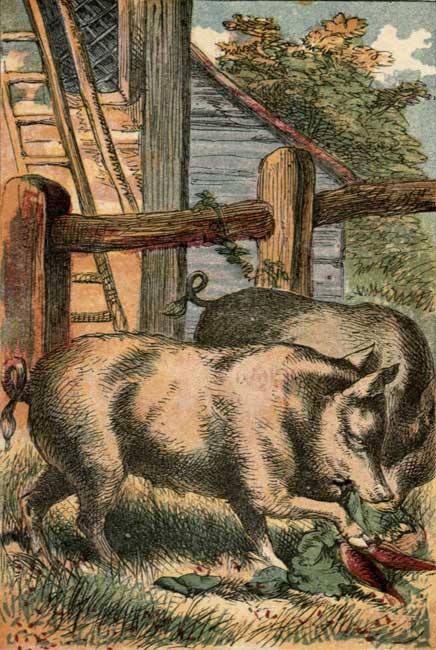 PIGS.
PIGS.NURSERY SONGS.
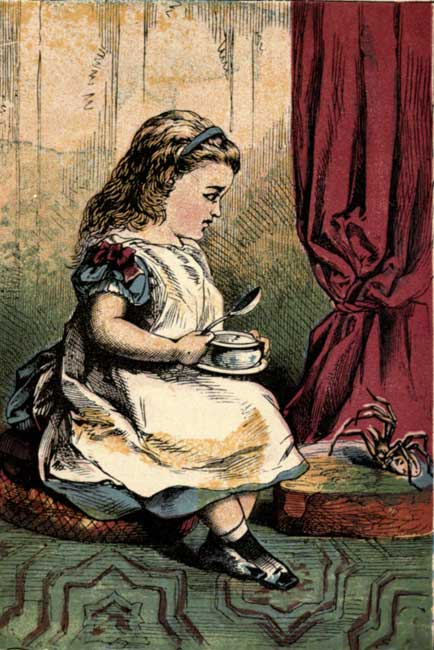 LITTLE MISS MUFFET.
Little Miss Muffet
She sat on a tuffet,
Eating of curds and whey.
There came a great spider,
Who sat down beside her,
And frightened Miss Muffet away.
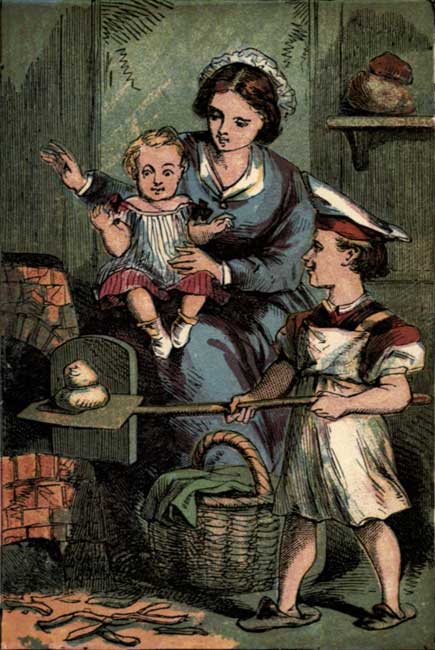 PAT-A-CAKE, PAT-A-CAKE.
Pat-a-cake, Pat-a-cake, baker’s man,
Make me a cake as fast as you can;
Pat it, and prick it, and mark it with T,
And send it home for Tommy and me.
Humpty Dumpty sat on a wall,
Humpty Dumpty had a great fall;
All the king’s horses and all the king’s men
Could not set Humpty Dumpty up again.
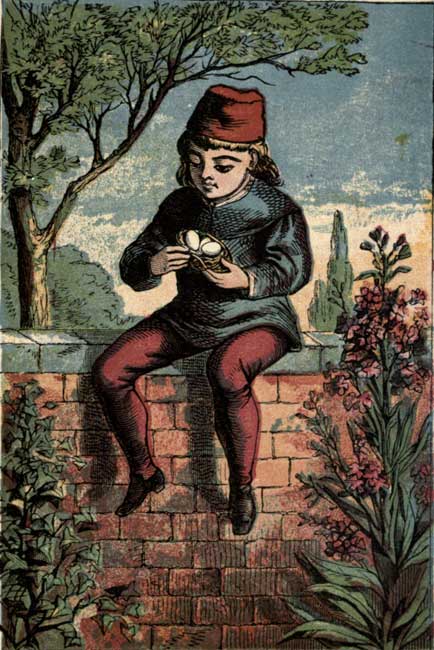 HUMPTY DUMPTY.
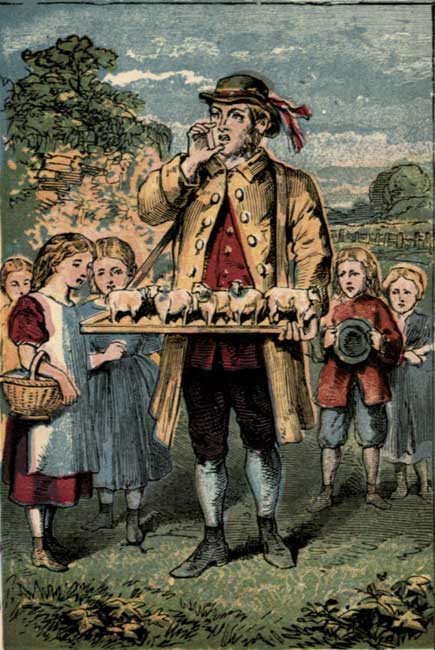 YOUNG LAMBS TO SELL!
Young lambs to sell!—young lambs to sell!
If I had as much money as I could tell,
I never would cry, Young lambs to sell!
Young lambs to sell!—young lambs to sell!
I never would cry, Young lambs to sell!
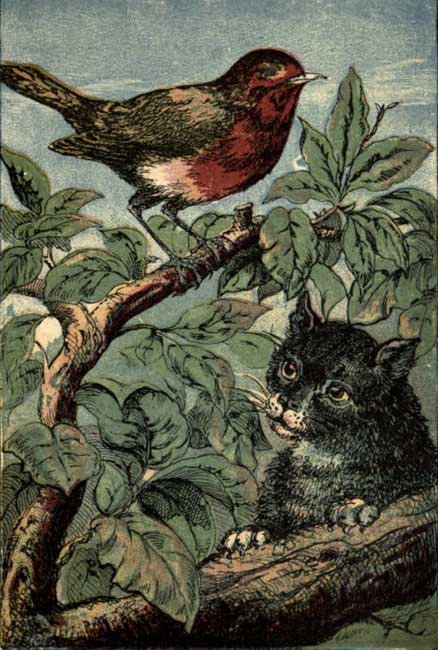 LITTLE ROBIN REDBREAST SAT UPON A TREE.
Little Robin Redbreast sat upon a tree,
Up went Pussy-cat, and down went he;
Down came Pussy-cat, and away Robin ran;
Says little Robin Redbreast, “Catch me if you can.”
Little Robin Redbreast jumped upon a wall,
Pussy-cat jumped after him and almost got a fall;
Little Robin chirped and sang, and what did Pussy say?
Pussy-cat said “Mew,” and Robin jumped away.
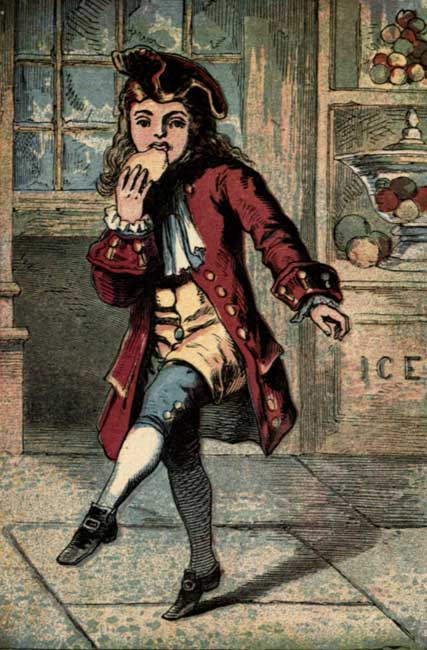 HANDY SPANDY, JACK-A-DANDY.
Handy Spandy Jack-a-Dandy
Loved plumcake and sugar candy;
He bought some at a grocer’s shop,
And out he came, hop, hop, hop.
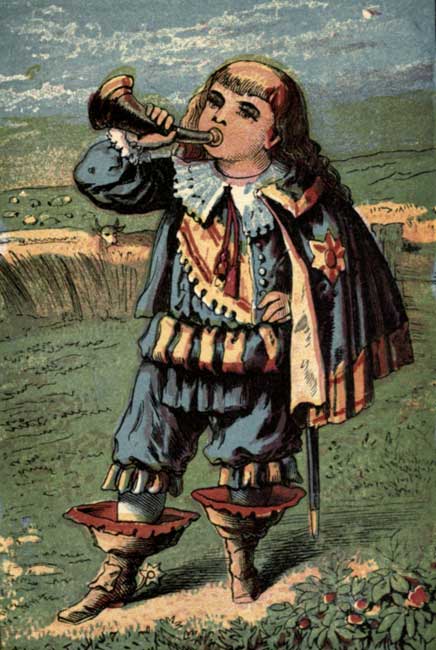 LITTLE BOY BLUE.
Little Boy Blue, come blow up your horn,
The sheep’s in the meadow, the cow’s in the corn.
Where’s the little boy that looks after the sheep?
He is under the hay-cock fast asleep.
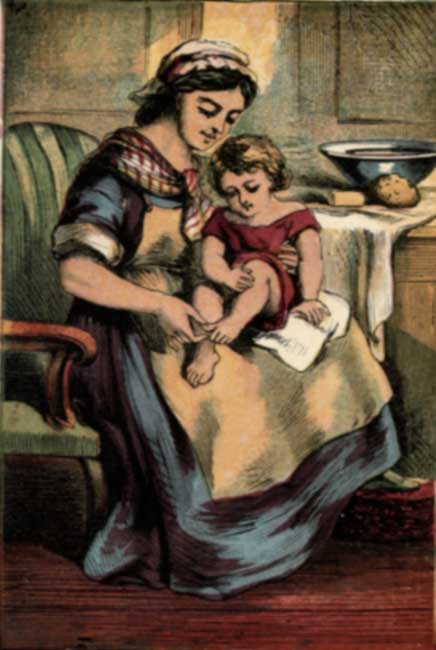 THIS LITTLE PIG WENT TO MARKET.
This little pig went to market;
This little pig stayed at home;
This pig had a piece of bread-and-butter;
This little pig had none;
This little pig said, “Wee, wee, wee!
I can’t find my way home.”

NURSERY RHYMES.
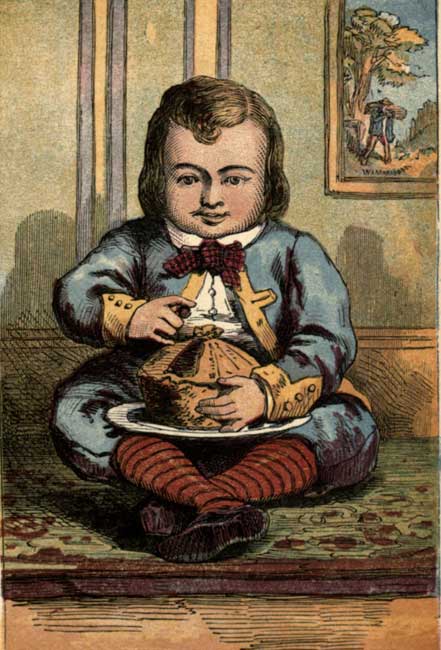 LITTLE JACK HORNER.
Little Jack Horner sat in a corner,
Eating his Christmas Pie;
He put in his thumb, and pulled out a plum,
And said, “What a good boy am I!”
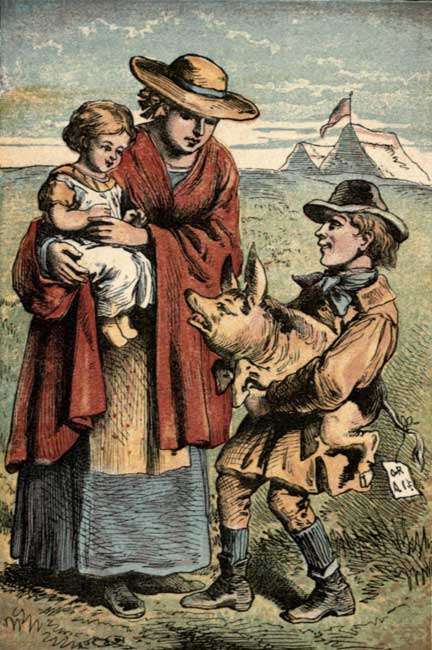 TO MARKET, TO MARKET.
To market, to market, to buy a fat pig;
Home again, home again, jiggetty-jig.
To market, to market, to buy a fat hog;
Home again, home again, jiggetty-jog.
Taffy was a Welshman,
Taffy was a thief;
Taffy came to my house
And stole a piece of beef.
I went to Taffy’s house,
Taffy was from home;
Taffy came to my house
And stole a marrow bone.
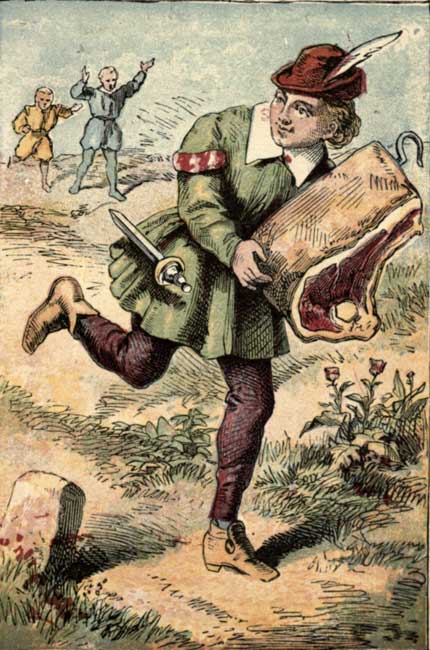 TAFFY WAS A WELSHMAN.
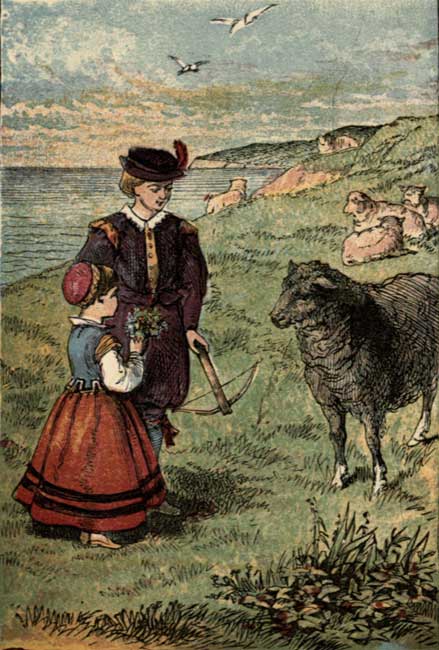 BAA, BAA, BLACK SHEEP.
Baa, baa, black sheep,
Have you any wool?
Yes, marry, have I,
Three bags full:
One for my master,
One for my dame;
But none for the little girl
That cries in the lane.
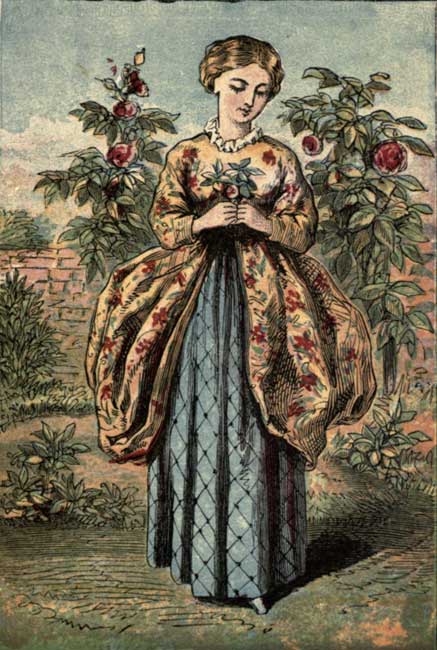 PRETTY MAID, PRETTY MAID.
Pretty maid, pretty maid, where have you been?
Gathering a posie to give to the Queen.
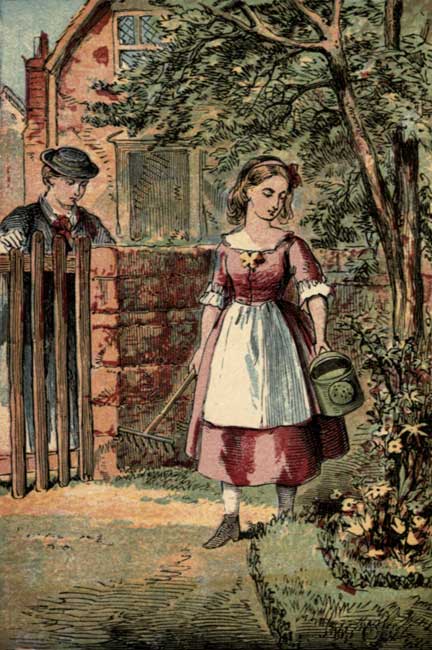 MARY, MARY, QUITE CONTRARY.
Mary, Mary, quite contrary,
How does your garden grow?
Silver bells and cockle-shells,
And columbines all of a row.
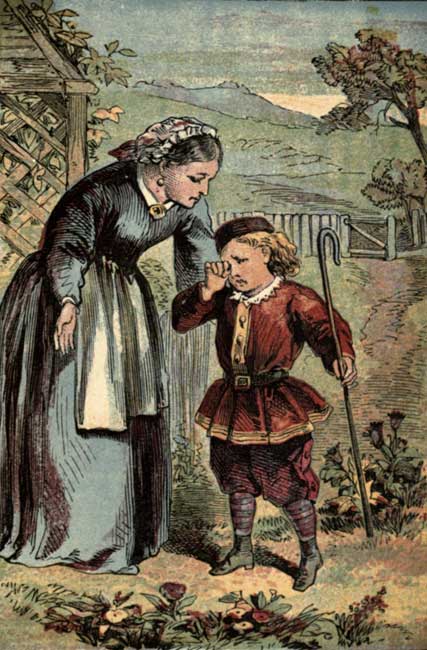 LITTLE BO-PEEP.
Little Bo-Peep has lost his sheep,
And cannot tell where to find them
Leave them alone, and they’ll come home,
And bring their tails behind them.
Little Bo-Peep fell fast asleep,
And dreamt he heard them bleating
When he awoke, he found it a joke,
For still they all were fleeting.
Then up he took his little crook,
Determined for to find them;
He found them indeed, but it made his heart bleed,
For they’d left their tails behind them.
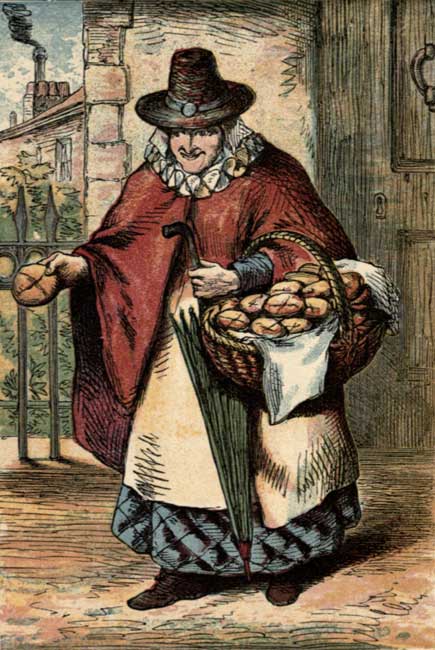 HOT CROSS BUNS.
Hot Cross Buns!
Hot Cross Buns!
One a penny, two a penny, Hot Cross Buns.
Hot Cross Buns!
Hot Cross Buns!
If you have no daughters, give them to your sons.
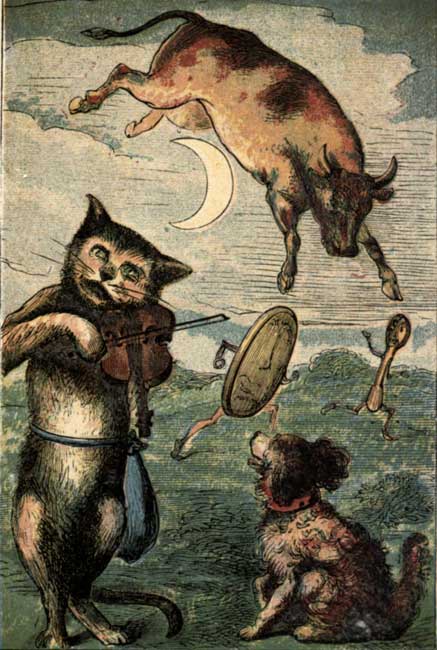 THE CAT AND FIDDLE.
Hey diddle diddle,
The cat and the fiddle,
The cow jumped over the moon,
The little dog laughed
To see the sport,
While the dish ran after the spoon.
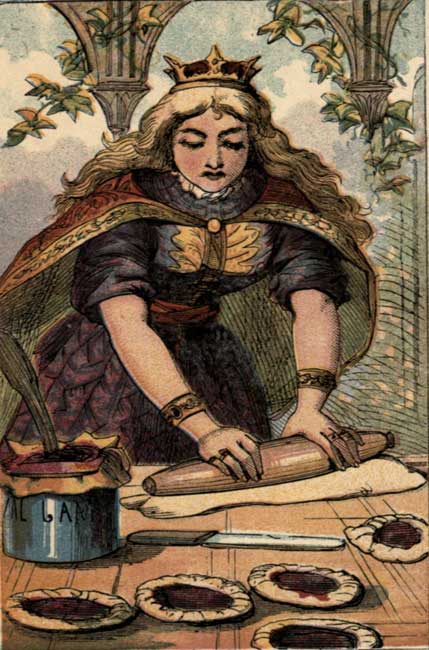 THE QUEEN OF HEARTS.
The Queen of Hearts,
She made some tarts
Upon a summer day;
The Knave of Hearts,
He stole those tarts,
And took them quite away.
The King of Hearts,
He missed those tarts,
And beat the knave full sore;
The Knave of Hearts
Brought back those tarts,
And vowed he’d steal no more.
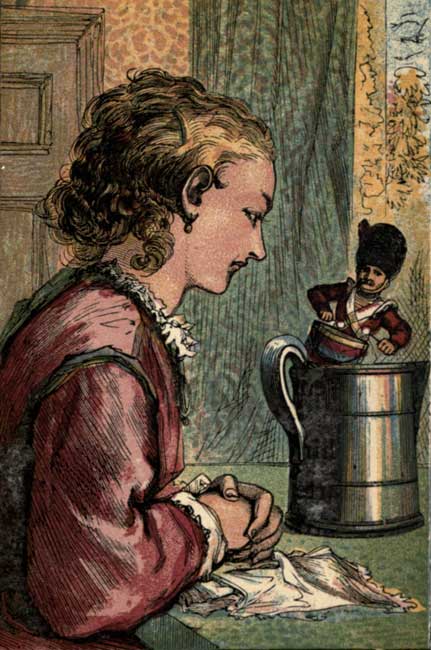 I HAD A LITTLE HUSBAND.
I had a little husband,
No bigger than my thumb;
I put him in a pint-pot,
And there I bid him drum.
I bought a little horse,
That galloped up and down;
I bridled him and saddled him,
And sent him out of town.
I gave him some garters,
To garter up his hose,
And a little handkerchief
To wipe his pretty nose.
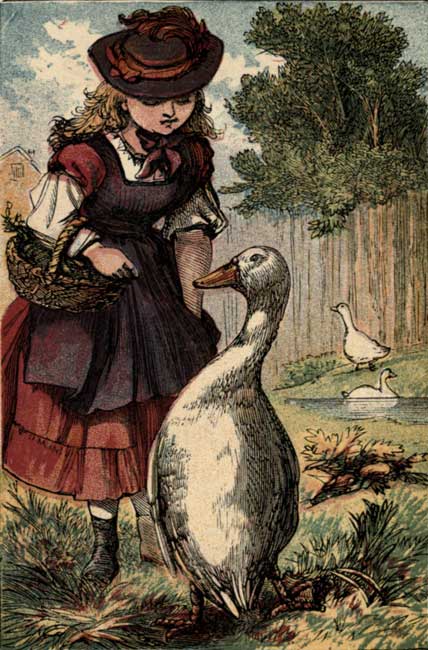 GOOSEY, GOOSEY, GANDER.
Goosey, Goosey Gander,
Where shall I wander?
Up stairs, down stairs,
In my lady’s chamber.
There I met an old man
That would not say his prayers;
I took him by the left leg,
And threw him down stairs.
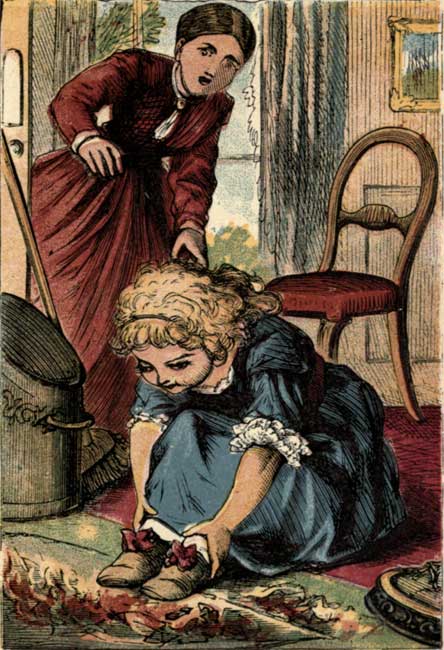 LITTLE POLLY FLINDERS.
Little Polly Flinders,
Sat among the cinders,
Warming her pretty little toes;
Her mother came and caught her,
And scolded her little daughter,
For spoiling her nice new clothes.
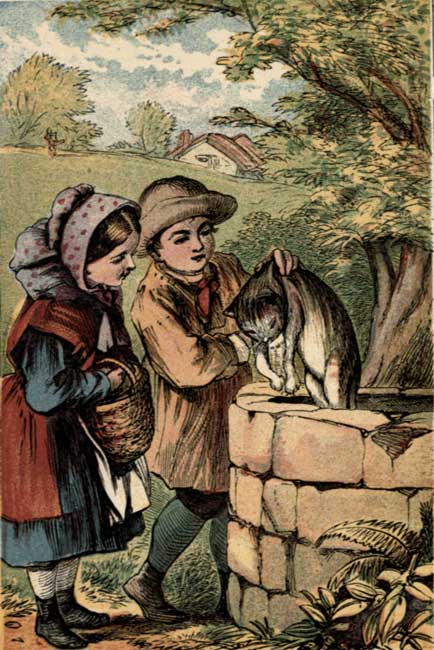 DING DONG BELL.
Ding Dong Bell,
Pussy’s in the well.
Who put her in?
Little Tommy Lin.
Who pulled her out?
Little Tommy Trout.
What a naughty boy was that,
To drown poor little Pussy cat,
Who never did him any harm,
But killed the mice in his father’s barn.
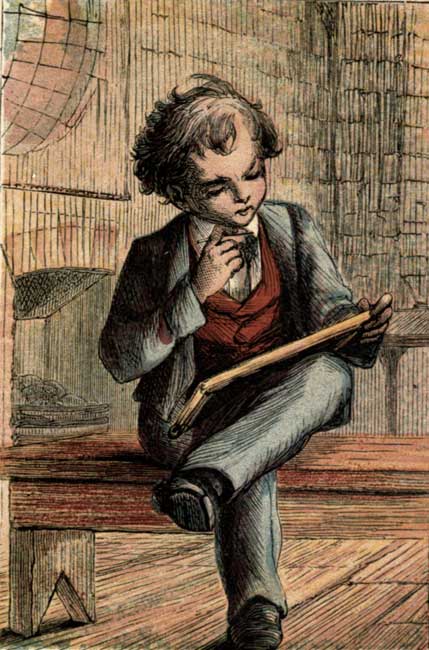 “MULTIPLICATION IS VEXATION.”
Multiplication is vexation;
Division is as bad;
The Rule of Three doth puzzle me,
And Practice drives me mad.
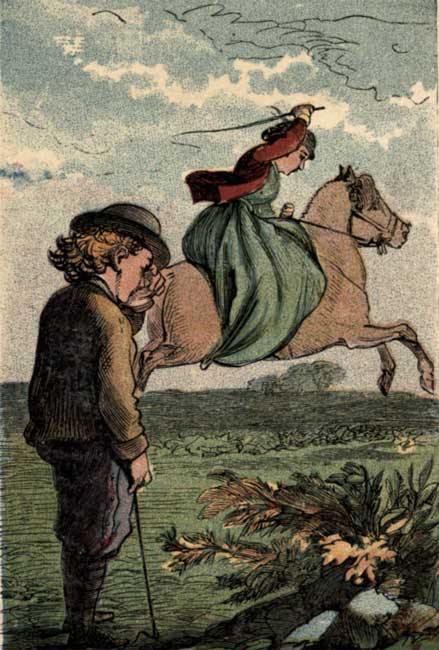 THE DAPPLE-GREY PONY.
I had a little pony,
His name was Dapple Grey,
I lent him to a lady,
To ride a mile away.
She whipped him, she slashed him,
She rode him through the mire;
I would not lend my pony now,
For all the lady’s hire.
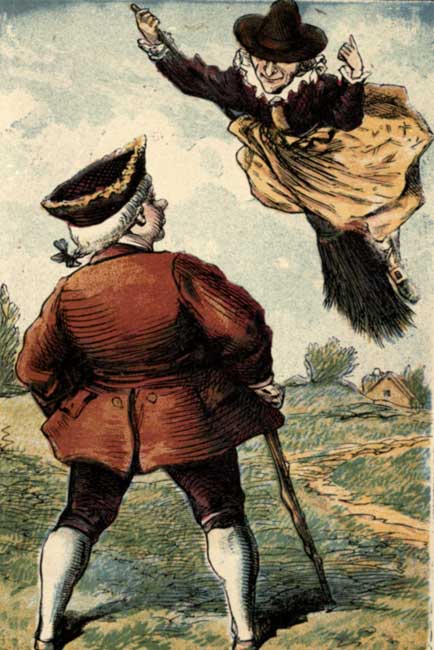 OLD WOMAN, OLD WOMAN, SAYS I.
Old woman, old woman, old woman say I,
O whither, O whither, O whither so high?
To sweep the cobwebs off the sky.
Shall I go with you? Ay, by-and-by.
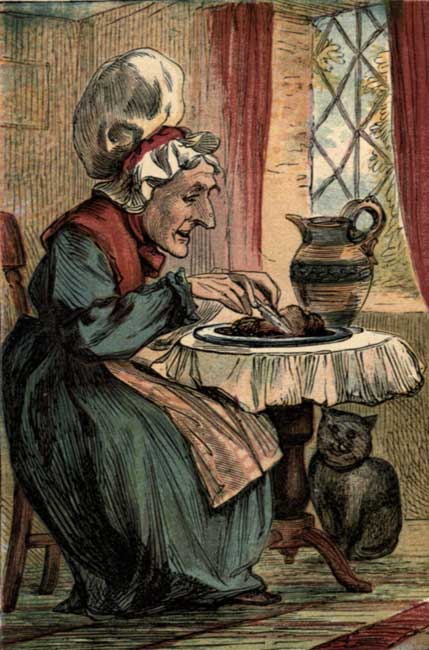 DAME TROT AND HER CAT.
Dame Trot and her cat
Led a peaceable life
When they were not troubled
With other folks’ strife.
When Dame had her dinner
Puss near her would wait,
And was sure to receive
A nice piece from her plate.
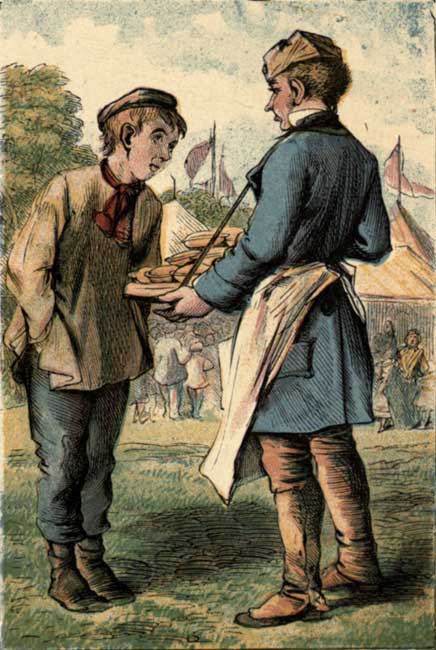 SIMPLE SIMON.
Simple Simon met a pieman
Going to the fair;
Says Simple Simon to the pieman,
“Let me taste your ware.”
Says the pieman to Simple Simon,
“Show me first your penny.”
Says Simple Simon to the pieman,
“Indeed, I have not any.”
Simple Simon went a-fishing
For to catch a whale;
All the water he had got
Was in his mother’s pail.
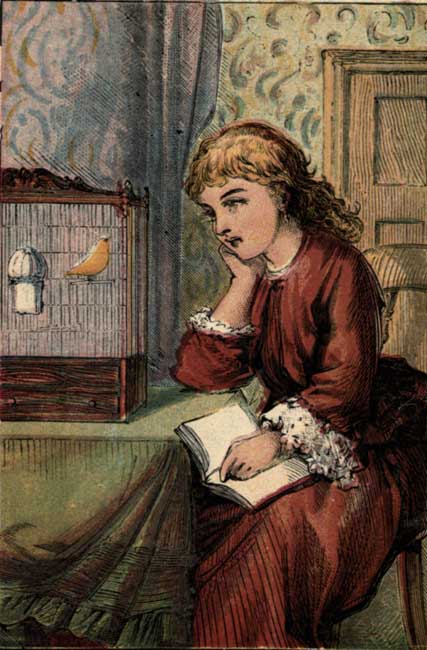 MARY HAD A PRETTY BIRD.
Mary had a pretty bird,
With feathers bright and yellow,
Slender legs—upon my word,
He was a pretty fellow.
The sweetest notes he always sang,
Which much delighted Mary;
And near the cage she’d ever sit,
To hear her own Canary.
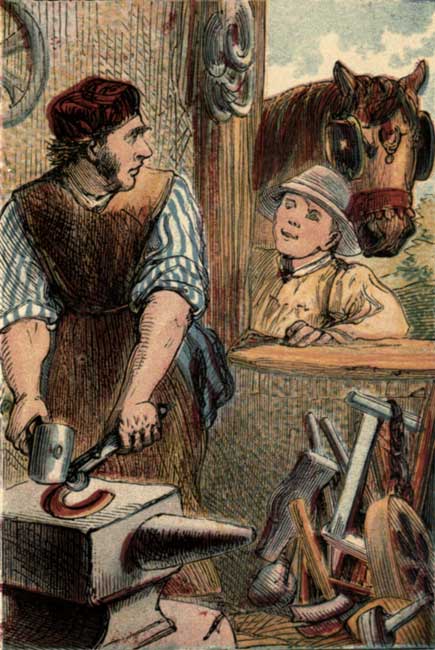 IS JOHN SMITH WITHIN?
Is John Smith within?
Yes, that he is.
Can he set a shoe?
Ay, marry, two;
Here a nail and there a nail,
Tick, tack, too.
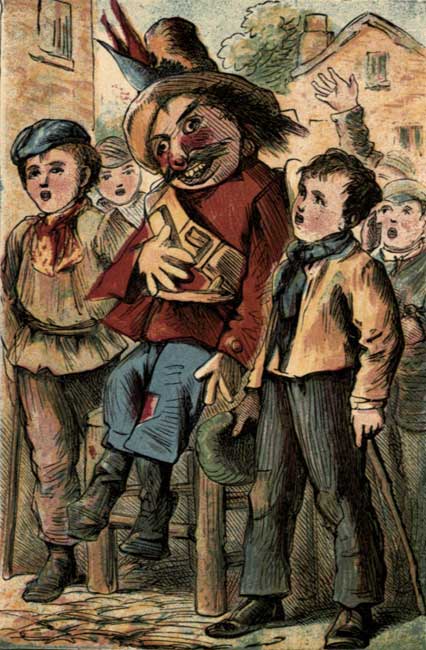 GUY FAWKES.
Please to remember
The fifth of November,
Gunpowder treason and plot.
I know no reason
Why gunpowder treason
Should ever be forgot.
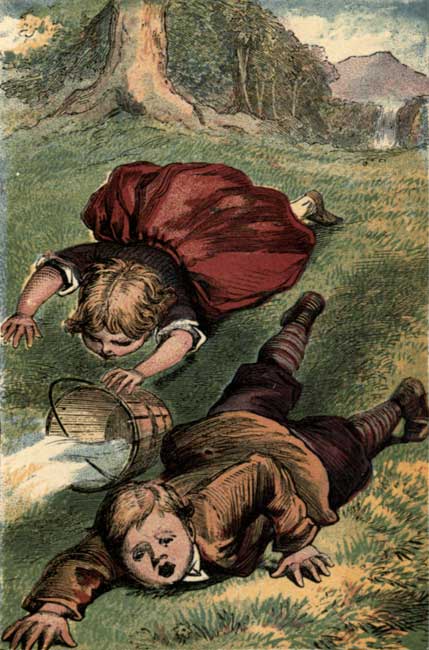 JACK AND JILL.
Jack and Jill went up the hill
To fetch a pail of water.
Jack fell down and broke his crown,
And Jill came tumbling after.
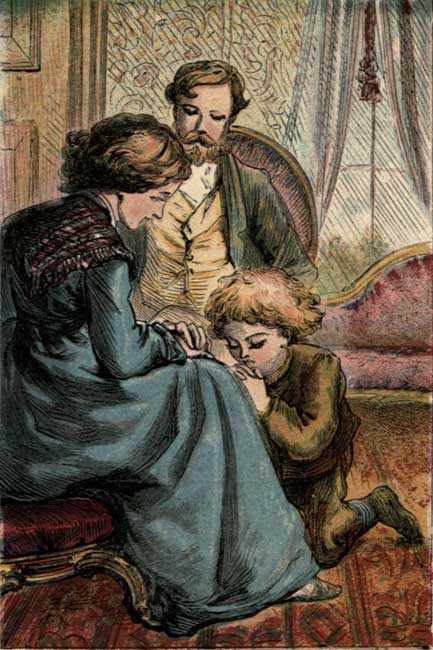 LITTLE FRED.
When little Fred went to bed,
He always said his prayers.
He kissed mamma and then papa,
And straightway went upstairs.
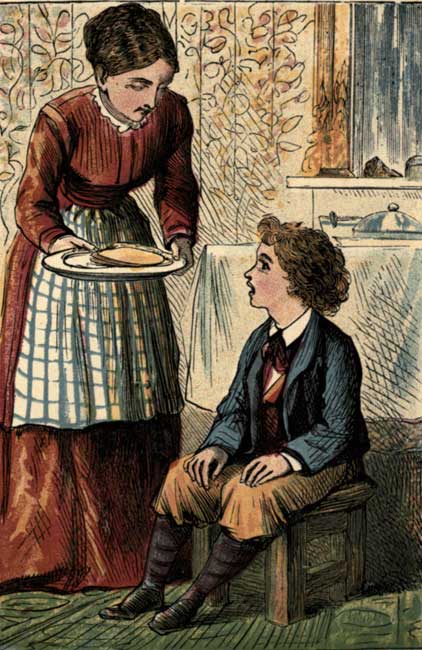 LITTLE TOM TUCKER.
Little Tommy Tucker,
Sings for his supper.
What shall he eat?
White bread and butter.
How shall he cut it
Without e’er a knife?
How will he be married
Without e’er a wife.
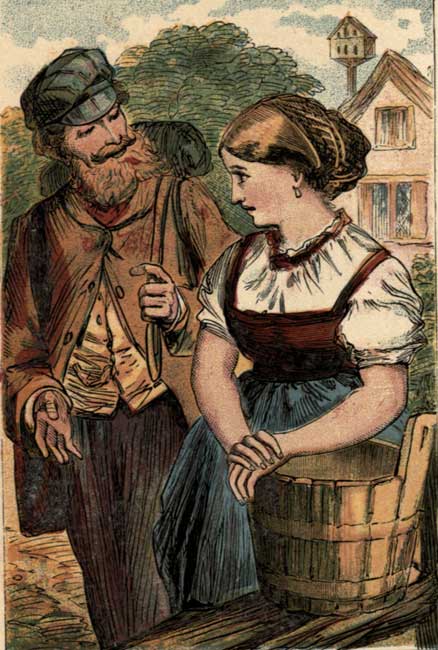 WHERE ARE YOU GOING, MY PRETTY MAID?
Where are you going, my pretty maid?
I’m going a milking, sir, she said.
May I go with you, my pretty maid?
You’re kindly welcome, sir, she said.
What is your fortune, my pretty maid?
My face is my fortune, sir, she said.
Then I won’t marry you, my pretty maid.
Nobody asked you, sir, she said.
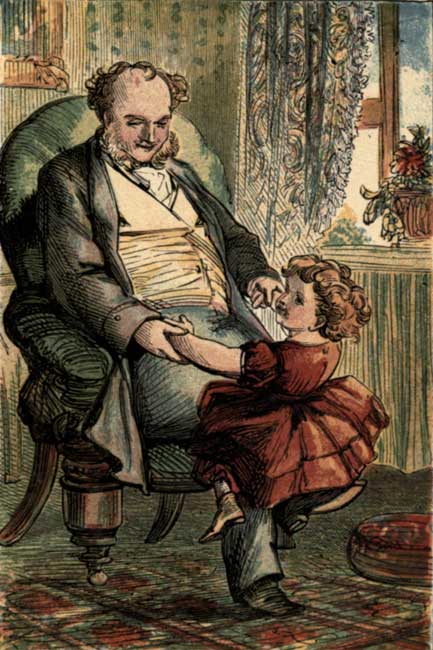 RIDE A COCK-HORSE.
Ride a cock-horse to Banbury Cross,
To see an old lady upon a white horse;
Rings on her fingers and bells on her toes,
And so she makes music wherever she goes.
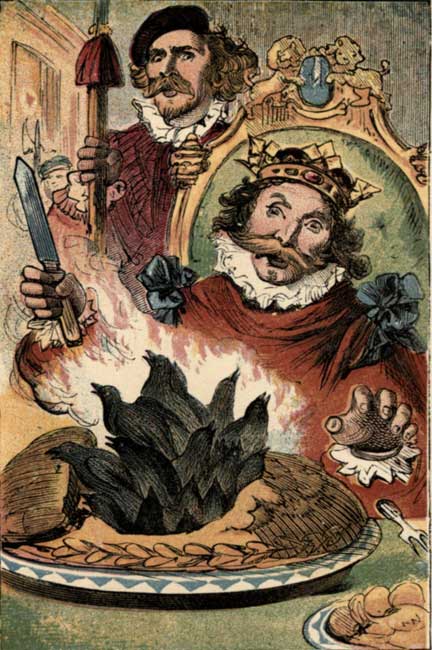 SING A SONG OF SIXPENCE.
Sing a song of sixpence,
A bag full of rye;
Four-and-twenty blackbirds
Baked in a pie.
When the pie was opened
The birds began to sing.
Was not that a dainty dish
To set before the king?
The king was in his countinghouse,
Counting out his money;
The queen was in the parlour,
Eating bread and honey.
The maid was in the garden,
Hanging out the clothes;
‘Long came a blackbird
And snapt off her nose.
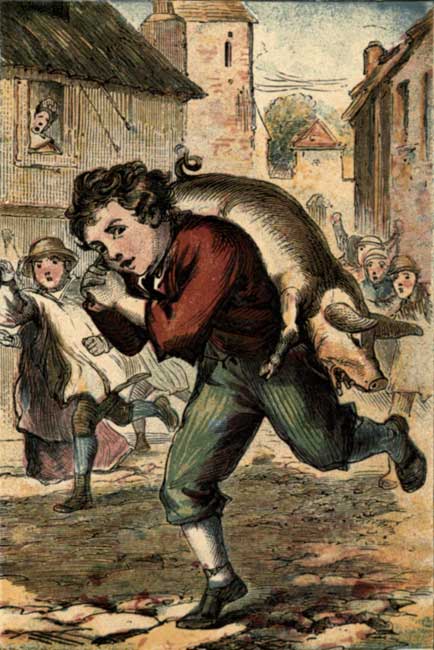 TOM, TOM, THE PIPER’S SON.
Tom, Tom, the piper’s son,
Stole a pig and away he run!
The pig was eat, and Tom was beat,
And Tom went roaring down the street.
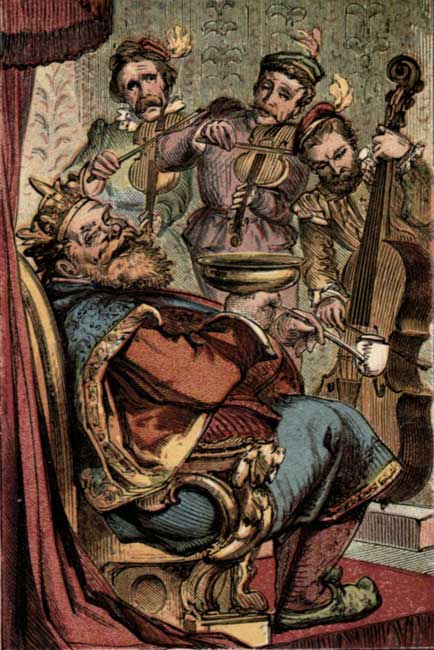 OLD KING COLE.
Old King Cole
Was a merry old soul,
And a merry old soul was he!
He called for his pipe,
And he called for his bowl,
And he called for his fiddlers three.
Every fiddler he had a fiddle,
And a very fine fiddle had he!
Twee tweedle dee, tweedle dee went the fiddlers.
Oh, there’s none so rare
As can compare
With King Cole and his fiddlers three!
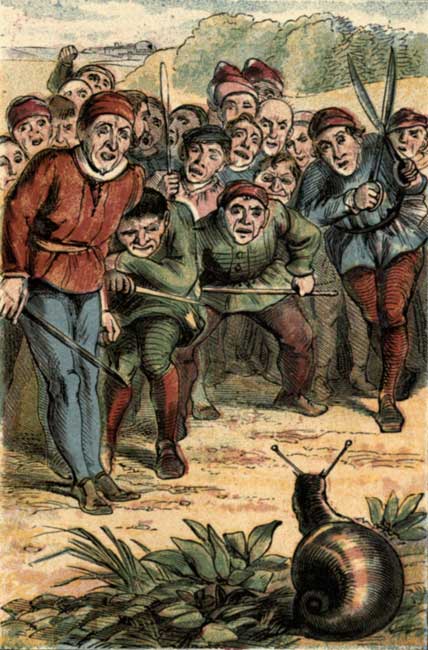 FOUR-AND-TWENTY TAILORS WENT TO KILL A SNAIL.
Four-and-twenty tailors went to kill a snail;
The best man among them durst not touch her tail.
She put out her horns like a little Kyloe cow.
Run, tailors, run, or she’ll kill you all e’en now.
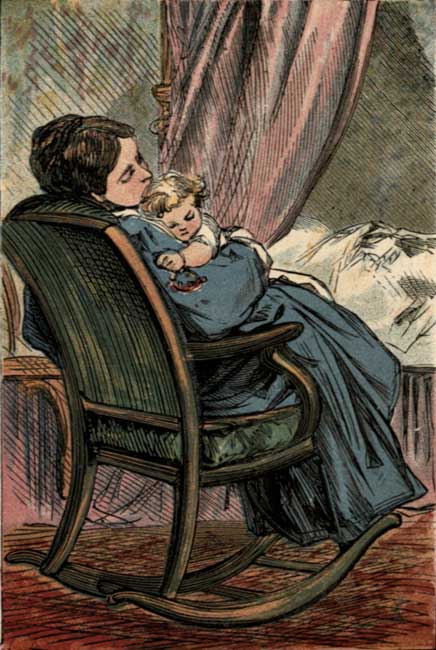 HUSH-A-BY BABY.
Hush-a-by, baby, thy cradle is green;
Father’s a nobleman; mother’s a queen;
Betty’s a lady, and wears a gold ring,
And Johnny’s a drummer and drums for the king.
| Mother Hubbard | |
| Cock Robin’s Death | |
| Tom Thumb | |
| Punch and Judy | |
| The Pets | |
| Nursery Songs | |
| Nursery Rhymes | |
| Nursery Ditties | |
| Nursery Tales | |
| Nursery Jingles | |
